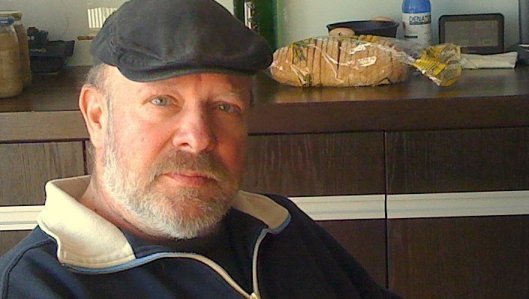
Antoni Walerych

Alles ist wahr und auch das Gegenteil
(Everything is real and the reverse as well)

Karl Kraus

Walerychiations on the theme of prickly Antek

Walerych is a a carrouser (reveller, merry-maker) and a playboy (spark, trifler) whose second, otherwise discreetly hidden face of a sensitive person is expressed through his art. You have been warned.

I dare call our relationship cordial. This is to clarify in case I were suspected of being impartial and objective. But isn’t subjectivity the natural characteristics of most opinions ever pronounced about art?

We met some time deep into the seventies of the last century when we both strove, unsuccessfully as it were, to be admitted to the fine art’s department of the Nicolas Copernicus University in Toruń. Apart from our friendship which, moderately cultivated, survived until today, those distant days and nights spent together have left two memories: a discreet bite of jealousy in the men’s rivalry to win the good graces of a beautiful woman we both adored (and whom Antek finally won), and Antek’s contagious passion for Richard Wagner’s music whose virus he passed onto me. While my passion remained a platonic one, Antoni’s has grown to be very intense and active. His sculptural output has been intertwined with the musical thread, not only Wagnerian.

Since those times each of us has followed his own ways. Antoni reached his goal and became a father to a bunch of kids and a sculptor, I took to journalism by coincidence. This however, does not explain why I am writing this text. Last year while navigating in the Web I happened to visit Antek's website with his sculpture and painting gallery. The longer I looked, the more I liked it. Fish (Ryby) emanated geometrical peace, Ducks on snow put me in such a good mood that I wrote to Antek :”My congratulations. I envy people who have these paintings at home. Your painting is like a clear distillate of some noble liquor, or like a crystal charming with its ideal structure.” I still believe it.

I suppose that this glimpse of my uncontrolled exuberance lay at the origin of Antek's insidious idea to abandon the services of a professional critic and charge an amateur admirer like me with the task of writing this preface. Using a few insolent compliments and his innate Poznań-made merchant’s talent he worked me like a sculptor works his clay, with much ease and expertise.

Obviously, I look at Antoni’s art with an unaided eye and no professional critic’s equipment at hand. But my eye is anything but innocent. Immersed as we are in a sea of icons, millions of images, scenes and pictures that we happened to see throughout our lifetime have been imprinted in our subconscious. We have seen them live, in the original, or in a film or paper reproduction, and with time they have merged into a background which is now the private context for Antek’s art.
Antoni Walerych - artysta rzezba rzezba obraz
An additional complication adds to the picture. I remember perfectly well my disappointment at seeing the original Blue vase by Cezanne which I had earlier admired in reproduction. The vase was so small and faded compared to rich colours suggested by reproductions! I am ashamed to confess that I have not seen the major part of Antek’s original works. But this is not to be considered as an obstacle. As I have not started to despise Cezanne once I saw the real Blue Vase, the original works by Walerych surely will not make me loose my taste for his art. Between the original work of art and its reproduction there is enough room for falsified impressions and emotions, but also going into raptures, whichever the direction.

A photo would probably not capture my attention for a long time. But Antoni took me once to see his Christ crucified in the church in Swarzędz. This felt like a lightning. The steel of the mutilated body against the white wall has remained in my head firm like an oxidised nail. I remember a strange relief I felt staring at the Crucified. It was as if the powerful katzenjammer of life had evaporated, the air growing luminous with the certainty that no sin is final because it has already been expiated by consenting to horrible suffering. In fact, I thought, he had mutilated himself, and his torturers were but necessary tools, just like Judas. The Gnostic ghost encouraged to ask questions on the role of the Father and his cruel kindness. The Gospel told us what happened next : he resurrected, went to Heaven, sits on the right hand of the Father, and his kingdom... Fortunately Antek does not complete this phrase. Is it only because the parish-priest had not placed an appropriate order? Or maybe because the artist does not grant himself the right to express and visualise with his sculpture the sequel of the Passion of Christ and His Resurrection?

I am the happy owner of two gifts from Antek. The first one is a superbly sculptured Wagner’s head. The second one is the painting entitled About aunt Pola who, having stretched her body in the window, started to slur late uncle Edward’s reputation. You have to see the painting to understand and taste the humour of this literary supplement. Behind the mask of Antek’s sense of humour there lies a deeply hidden unsatisfiable yearning for a complete, integral and all-embracing work of art.

Antoni Walerych - artysta rzezba rze.ba obraz Antoni’s nudes are soaring. They evolve not only from his sexual desire for the fair sex, but also from this wonderment, curiosity and fascination with the woman’s secret difference. Interestingly, none of the synonyms used to denote a “woman” fits in the description of his paintings: neither lady, nor chick, gal, kitten, girl, lass, female, spinster, mother, matron..... The only adequate term is the woman as studied by Walerych in thousands of variants. Not all parts of the body are scrutinised with the same care and patience. The most secret and attractive zone stretches from chin to knees. The face is not important, just an oval shape, feet do not really matter either. The essential thing is in between: shoulders, breasts always slender, strong thighs. Curiously enough, the nudes painted by Antoni, womaniser as he is, are neither carnal, nor sexual. Silhouettes are not round shaped or oval, on the contrary, sketched with a sharp line, they are audacious, geometrical and square-edged, but do not hurt the spectator’s eyes. It is as if packed his portraits to make them safe for the heroine. Any alleged caresses, interior intimacy, subtle feelings are encased by the painter in barbed armour. Is it because of jealousy, admiration, gentleness, mercenary motives? Maybe the apparently raw form is an attempt to defend against the omnipresent lewd insolence of a voyeur. I would understand that.

Despite the above divagations I look at Antoni’s art like a consumer, with no celebration and reverence. Maybe this is because I believe the most interesting part of art to be “in between” the artistic avant-garde and the commercial stereotype. Over ninety years have passed since Marcel Duchamp’s audacious gesture of presenting a toilet bowl ironically named “Fountain” as a work of art. Unfortunately some ambitious avant-garde members have copied this once revolutionary concept in thousands of variants, reducing it to a mere banality. With such background Antoni appears as an artist following the tradition in good taste. He does not fulfil a mission, or revolt, or spill his guts out, or fight for the “cause”. He is, as Konwicki put it, a sensitive “remiecha” who skilfully and with much intuition balances in the middle zone between the poles of the sophisticated and the popular culture.

I have not the faintest idea whether Antoni’s art will pass to the history, or not. Not that I really care. It has already passed to my private history and I like it. You are free not to agree.

Konrad Stanglewicz

Antoni the submissive

The space is liberated, and then embraced by him with a steel form, gently, timidly, almost tenderly. Steel, a hard material used to arouse terror in the human history, becomes a melody in Antoni’s huge hands. His work is characterised by simplicity, ascetism, honesty of message, and human scale perception. He tames the chaos of steel strings joining them with gold. Freely using the three dimensions, he reaches the fourth - the space for music.
Given such unwavering nobility of choice, in the works signed Walerych there is no Antoni... just sculpture.

Henryk Starikiewicz
Kontakt | ©2011 OpenSite | Projekt i wykonanie: Yunnan | Valid HTML 4.01 ! | Valid CSS ! | Link |
| Yunnan | OpenSite www |
| Domy prefabrykowane | Kursy maturalne | Üebersetzer in Polnisch |